04: Language as Compression of the World: Why Prediction Can Become Intelligence

This is the fourth post in the “Understanding LLMs from First Principles” series. Post 03: Transformer and Attention explained how a model builds relationships between tokens inside context. Now we move one layer deeper: if the training objective is only to predict the next token, why do large language models show knowledge, reasoning, translation, coding, planning, and explanation abilities? This post opens that question: why can language act as a compression of the world?
So far, we have built this technical chain:
Text
→ token
→ embedding
→ Transformer
→ probability distribution over the next token
If we only look at this chain, an LLM seems like an extremely complex continuation machine.
Give it a sentence, and it predicts the next token. Put that token back into the context, predict the next one, and repeat. A full answer appears one token at a time.
That leads to the natural objection:
Isn't it just guessing the next word?
Why does it look like it can think?
This question matters because bad answers lead to two opposite mistakes.
One mistake is to mystify LLMs, as if some unexplained consciousness appeared inside the model.
The other mistake is to shrink LLMs into “fancy autocomplete,” as if all capability were just accidental text stitching.
Neither view is precise enough.
A better first-principles explanation is:
A language model does not learn language because it wants to understand the world. It learns part of the world’s structure because that structure is necessary for predicting language.
In other words, next-token prediction is the surface task. What gets compressed into the model’s parameters is the structure needed to perform that task well.
1. Language Is Not Random Symbols. It Is a Trace of the World
Start with a simple prompt:
A glass fell off the edge of the table, and then it probably...To predict the continuation, the model cannot only know which words often follow “fell off.” It also needs a lot of implicit structure:
A glass is an object.
A table has height.
Objects fall under gravity.
Glass or ceramic objects may break.
People often describe this scene with words like "hit the floor," "shattered," or "made a noise."
Now consider another prompt:
After reviewing the test results, the doctor advised the patient to...To predict the next text, the model needs to capture:
the role relationship between doctor and patient;
the link between test results, diagnosis, treatment, and follow-up;
the fact that "advised" usually introduces an action plan;
the need for caution in medical language.
These are not properties of one word alone, and they cannot be fully derived from grammar. They come from society, physics, roles, habits, procedures, and expression patterns.
Language is a sequence of symbols on the surface, but those symbols are connected to the world behind them.
Articles, conversations, code, manuals, papers, contracts, reviews, tutorials, and chat logs are all textual traces of world activity.
A recipe compresses a cooking process.
A medical record compresses a clinical process.
Code compresses program behavior.
A contract compresses rights and obligations.
A paper compresses observation, experiment, and argument.
A chat log compresses intention, emotion, and relationship.
So language is not an isolated symbol game. It is the world’s projection into text space.
If a model is trained to predict this text at large scale, across many domains, it cannot get very far by learning only surface word frequency. To reduce prediction error, it has to learn stable structures behind the text.

2. Predicting Language Forces the Model to Learn Hidden Variables
Imagine a model sees this opening:
Ming left his umbrella in the office. When he got downstairs, he saw that it was raining heavily, so he...Reasonable continuations include:
went back to the office to get it.
called a coworker.
waited near the entrance for the rain to ease.
took a taxi home.
These continuations are not random. They depend on hidden variables that are not written directly:
Ming does not want to get wet.
An umbrella protects against rain.
The umbrella is still in the office.
People choose actions based on goals.
Different actions have different costs.
These variables are not explicit fields in the text, but they shape what the text can reasonably say next.
During training, the model repeatedly performs one task:
Given previous text, predict later text.If it only memorizes local word pairings, it breaks as soon as the sentence changes:
Ming left his raincoat in the office...
Ming left his laptop in the office...
Ming left the client contract in the office...
The surface pattern is similar, but the reasonable action changes. To predict well, the model needs to learn more abstract relationships:
What is this object used for?
What does the current situation require?
What is the person's goal?
What consequences follow from each action?
That is what hidden variables mean.
The text does not say them directly, but predicting the text requires inferring the state behind the text.
From this angle, next-token prediction is not a shallow task. On the surface, it predicts words. Under the surface, it pressures the model to build compressed representations of the world, tasks, and human expression.

3. Compression Is Not Memorization. It Is Reusable Structure
When we say “language is compression of the world,” it is easy to misunderstand this as:
The model memorizes all of its training data.That is not the point.
Large models do memorize some high-frequency facts, fixed phrases, and fragments of training data. But if memorization were the whole story, it would be hard to explain why models can handle new sentences, new code, new questions, and new combinations they have never seen.
A more accurate description is that the model learns lossy statistical compression.
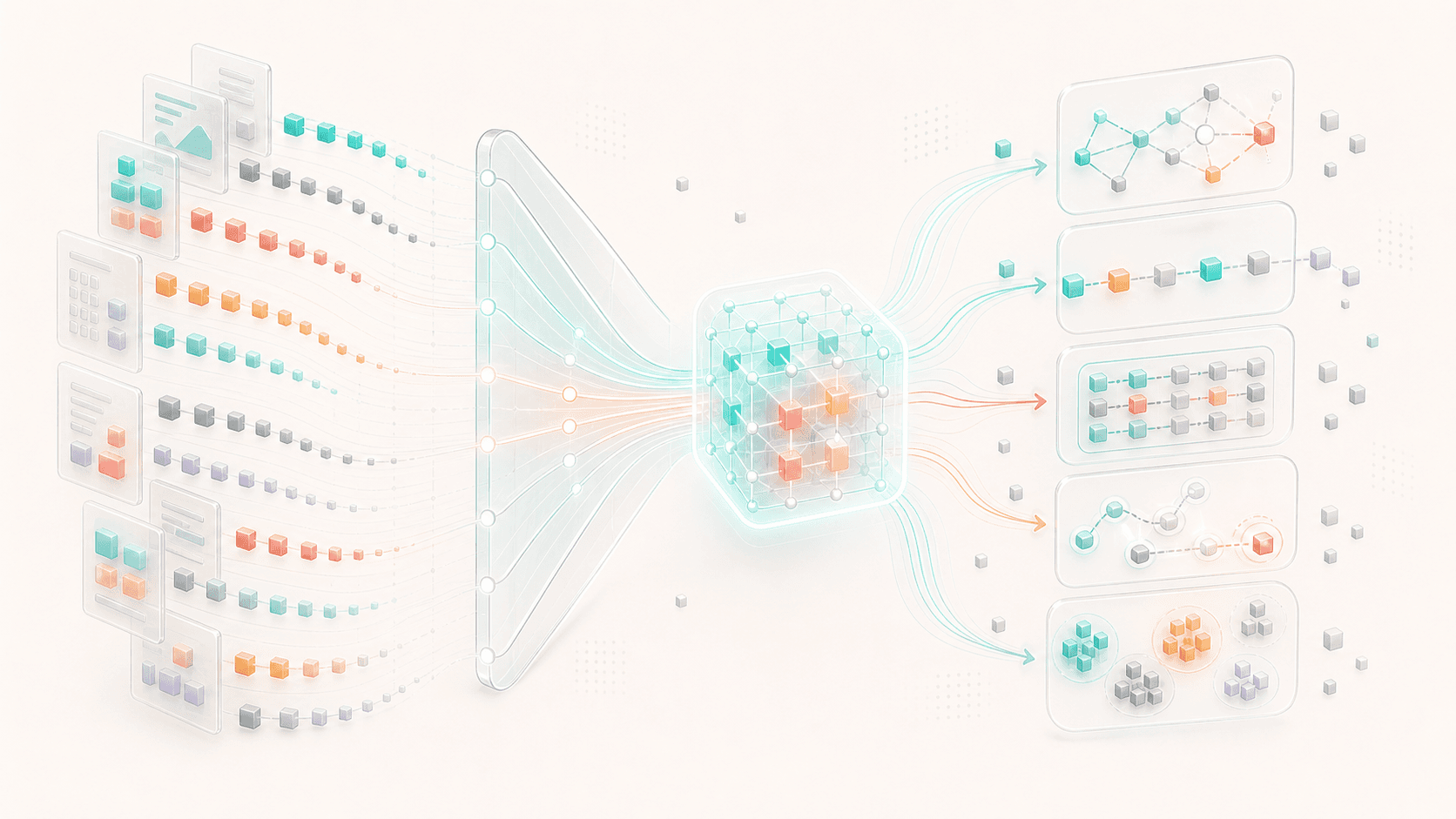
It cannot store the whole world inside its parameters. It also does not store every training document as a literal database. Instead, it compresses repeated structures, similar patterns, and reusable relationships from massive text into parameterized representations.
The process looks roughly like this:
Raw corpus: many specific sentences, paragraphs, code files, and conversations
↓
Training objective: predict the next token at each position
↓
Pressure: reduce overall prediction error
↓
Result: reusable language, knowledge, task, and reasoning structures form in the parameters
For example, the model sees many texts like:
Paris is the capital of France.
Tokyo is the capital of Japan.
Berlin is the capital of Germany.
Madrid is the capital of Spain.
If it only memorizes sentences, it can only answer pairings it has seen.
But if it learns a more abstract structure:
country -> capital
city -> country
"X is the capital of Y" expresses a relation
Then it can use that relation in many forms:
What is the capital of France?
Which city is the political center of France?
Paris is the capital of which country?
Translate "Paris is the capital of France" into Chinese.
That is the power of compression.
Good compression does not preserve every sample exactly. It finds the shared structure between samples.
A large part of LLM capability comes from reusing these structures.
4. Why This Compression Looks Like Knowledge
When we say a person “knows” something, we usually mean they can use it correctly across contexts.
For example, knowing that “water boils at about 100 degrees Celsius at standard atmospheric pressure” does not only mean repeating the sentence. It also means answering questions like:
Why does boiling water bubble?
Why does water boil more easily at high altitude?
If water has not reached its boiling point, does that mean it cannot evaporate?
These questions require using the fact inside different relationships.
Model knowledge is similar in one important sense.
The model does not open an internal encyclopedia entry and read out the answer. In the current context, it reactivates relationships compressed into its parameters, then generates the most likely continuation.
So we can define model knowledge as:
Compressed structure that reliably produces correct text behavior across many contexts.
This definition is a bit abstract, but useful.
It avoids two mistakes.
First, the model is not a database. It does not store every fact as a deterministic key-value pair.
Second, the model is not a pure random text machine. Its outputs are strongly constrained by the structures learned during training.
When those structures are rich enough, the model starts to show knowledge-like abilities:
explaining a concept;
rewriting the same meaning;
generalizing from one example to another;
adjusting expression when context changes;
combining multiple facts into one answer.
These abilities are not mystical. They are the result of large-scale language compression being unfolded again inside context.
5. Why This Compression Looks Like Reasoning
Knowledge is already useful. But the more surprising part is that models sometimes show reasoning-like behavior.
For example:
If all A are B, and all B are C, then all A are...A reasonable continuation is:
C.That looks like logical reasoning.
Or consider:
Someone puts a key in a drawer, then leaves the room. Another person moves the key into a box. When the first person returns, where will they look first?This question requires distinguishing reality from a person’s belief.
Why can abilities like this arise from text prediction?
Because a lot of text does not only state facts. It records reasoning processes.
Math problems record steps from conditions to conclusions.
Code records how inputs become outputs.
Tutorials record how goals break into actions.
Papers record hypotheses, evidence, and argument.
Legal text records rules, exceptions, and conditions.
Dialogue records intention, objection, concession, and clarification.
If the model wants to predict these texts, it cannot only learn what the next sentence looks like. It has to learn why one step follows another.
This is especially true in code, math, proofs, tutorials, and debugging traces. Local word frequency is not enough. To predict well, the model must learn some process structure:
how conditions constrain conclusions;
how variables change across steps;
how goals break into subgoals;
how causes propagate into effects;
how rules change under exceptions.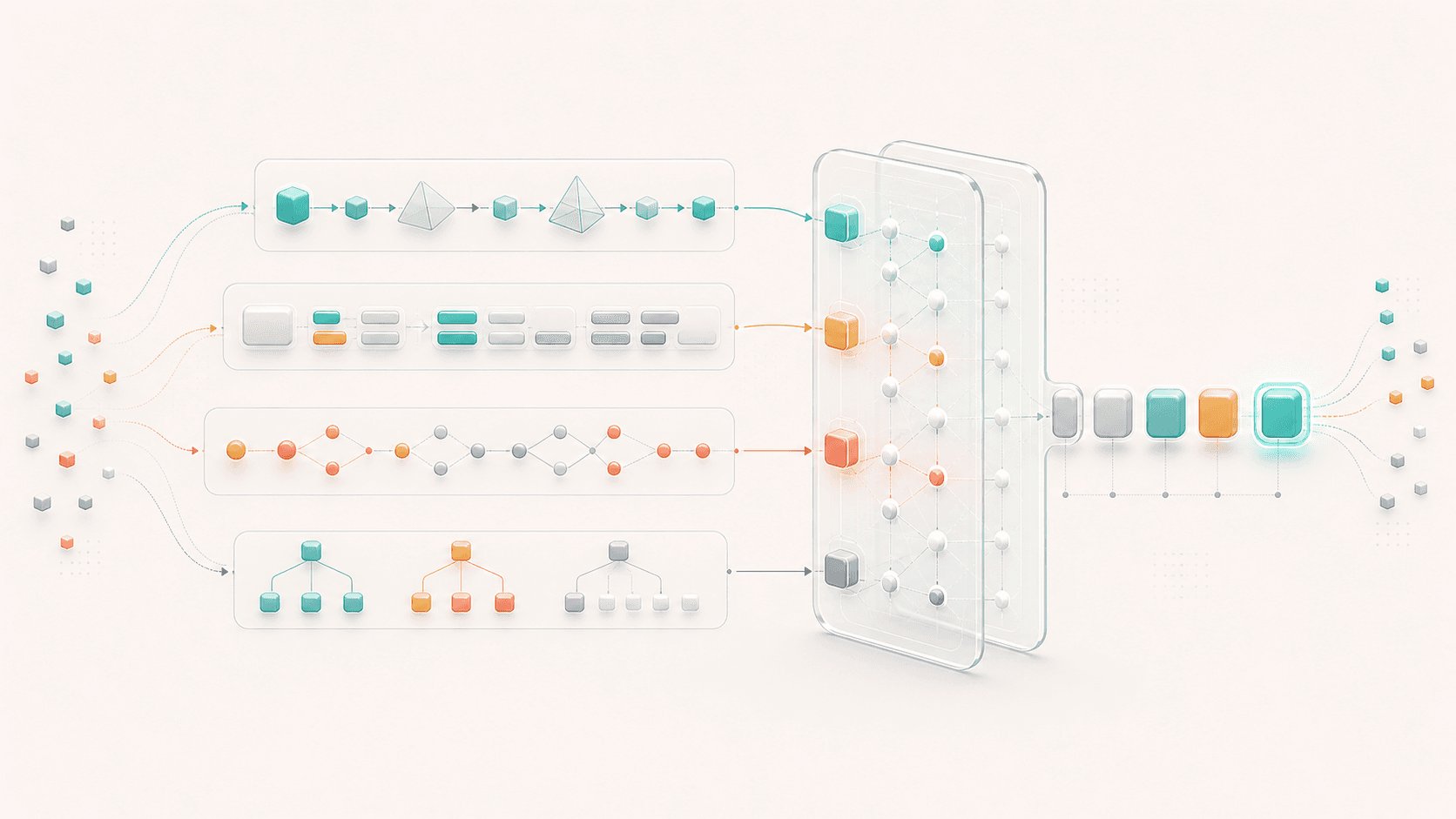
This is why chain-of-thought, scratchpads, and step-by-step prompts can help on many tasks.
They do not cast a spell on the model. They write the implicit reasoning process into the context, making it easier for the model to continue along process structures it learned during training.
But this is not a perfect symbolic reasoning engine.
The model can make mistakes inside plausible-looking steps. It can be misled by surface patterns. It can produce a fluent but false explanation.
The reason goes back to the first principle: the model generates the most probable token sequence under its learned distribution. It does not automatically produce conclusions verified by an external checker.
6. From Text World to Real World: Where the Boundary Is
If language compresses the world, does the model truly understand the world?
We need to be careful.
The model learns the world as mediated by language.
It has read descriptions of fire, but it has not been burned. It has read poems and weather reports about rain, but it has not felt cold wet air on skin. It can describe the bitterness of coffee, but it has no taste experience.
So its world model has natural boundaries.
First, it depends on training data and context. What is missing, rare, distorted, or biased in text is hard for the model to learn reliably.
Second, its knowledge is not automatically current. After training, the compressed structures inside parameters do not update as the world changes.
Third, it lacks direct action feedback. Humans see the consequences of actions. A base model usually only generates text, unless a system writes tool results, user feedback, or environment state back into the context.
Fourth, it lacks human bodily experience and subjective experience. It can model descriptions of experience, but that is not the same as having the experience.
This does not deny the model’s capability. It places the capability where it belongs.
LLMs are powerful because language really does compress a huge amount of world structure.
LLMs also fail because language is not the world itself, and predicting text is not the same thing as verifying facts.
7. What This Means for Products and Engineering
Once you understand “language as compression of the world,” many product and engineering decisions become clearer.
1. A Prompt Is Not a Spell. It Shapes a Predictable Task Distribution
A good prompt does not awaken the model with magic words. It writes the task as a familiar, clear, well-constrained text distribution.
For example, instead of:
Analyze this requirement.You can write:
Analyze this requirement from four angles: user goal, current obstacle, alternatives, and success metrics.
Use 3 bullets for each angle, then give one priority judgment.
The second prompt works better not because it is more polite, but because it puts task structure, output format, and evaluation dimensions into context.
The model can then generate along a more stable structure.
2. RAG Puts Missing World Facts Back Into Context
The model’s parameters compress the world seen during training. For recent information, internal company knowledge, personal data, live inventory, or changed regulations, parameters alone are usually not enough.
The value of RAG is not that it makes the model magically smarter. It puts task-relevant external facts into context, then lets the model use its existing language and reasoning structures to organize those facts.
Parameters provide general structure.
Retrieval provides current facts.
Context temporarily connects the two.
That is why the core of RAG is not only “finding documents.” It is finding the right documents and arranging them in a way the model can use.
3. Tool Use Compensates for the Boundary of “Only Predicting Text”
When a task needs deterministic calculation, database lookup, code execution, web retrieval, or system action, we should not rely only on knowledge compressed inside the model.
A better system design is:
The model understands intent, plans steps, and organizes language.
Tools fetch facts, execute actions, and verify results.
Tool results return to context.
The model generates the next step.
This does not turn the model into an all-powerful brain. It connects a language-compression system to feedback loops in the real world.
4. Evaluation Should Test Structure Reuse, Not Just Answer Similarity
If model capability comes from compressed structure, evaluation should not only ask a few memorized facts.
Better evaluation asks:
Can it handle expressions it has not seen?
Can it adapt under new constraints?
Can it transfer the same rule to a new situation?
Can it keep state consistent across multiple steps?
Can it recognize when external information is needed?
These questions are closer to the model’s real capability boundary.
8. Common Misunderstandings
Misunderstanding 1: If the model only predicts text, it cannot understand anything.
Not quite. The important question is not whether the objective is text prediction. The important question is what kind of text must be predicted. If text compresses rich world structure, predicting text forces the model to learn part of that structure. This is still not the same as human experiential understanding.
Misunderstanding 2: Model knowledge is just memorized training data.
Not quite. Memorization exists, but it is not the whole story. The more important capability comes from compressing reusable structures, which is why models can handle many new combinations.
Misunderstanding 3: Because the model talks about the world, it has real-world experience.
No. The model mainly learns textual traces of the world. It can model descriptions of experience without having the experience itself.
Misunderstanding 4: If we keep adding data, intelligence will grow without limit.
Not necessarily. Data scale matters, but so do data quality, architecture, training method, inference method, alignment, tool feedback, and evaluation. Compression has limits, and wrong compression can amplify bias.
9. Summary: Why Predicting Text Can Become Intelligence
We can compress this post into one chain:
The world produces events.
Humans record events, knowledge, rules, and processes in language.
Text forms a learnable language distribution.
The model learns that distribution by predicting tokens.
To predict better, the model is forced to compress structures behind language.
Those structures are reactivated inside context.
The result looks like knowledge, reasoning, rewriting, planning, and explanation.
If we compress it into one sentence:
An LLM predicts text, but it is forced to learn structures behind the text.
That is why “predict the next token” should neither be mystified nor dismissed.
It is not full human understanding. It is also not simple word chaining. It is a probabilistic compression system that learns world structure through language distribution.
Once this is clear, many later questions become easier:
Why is pretraining so important? Because it determines what world the model first compresses.
Why can fine-tuning and alignment turn a continuation machine into an assistant? Because they change the model’s output behavior distribution.
Why is hallucination hard to remove? Because generating text and verifying facts are not the same operation.
Why do tools, RAG, and agents matter? Because they connect the language-compression system back to world state and action.
In the next post, we will follow that turn: how does a pretrained model that only continues text become a system that follows instructions, cooperates with users, and behaves like an assistant?